What we will cover
Most plumbing companies make good money when the phone rings. The harder part is building a repeatable maintenance book before the next emergency.
A customer calls because water is already on the floor, a water heater is acting up, pressure keeps dropping, or a commercial tenant cannot wait until next week. The crew solves the urgent problem. Then the file goes quiet. No one has time to turn the call notes, photos, fixture age, shutoff location, pressure reading, and customer concern into a useful service plan.
AI can organize that history, watch for patterns, remind the office what needs checking, and draft a maintenance option for review. Keep diagnosis and approval with the plumbing team; the software only has the records it's given.
The immediate opportunity is follow through. Use what the tech already recorded to help the office decide whether a maintenance conversation makes sense.
The emergency loop keeps crews busy, but it is a rough way to grow
Emergency work will always matter in plumbing. Leaks, backups, failed water heaters, frozen lines, and pressure problems do not wait for a neat maintenance window. The problem is that an emergency only business model can make every week feel like dispatch triage.
Planned visits can give the office room to schedule, give techs a better job history, and help customers address recurring concerns. But the service plan needs a reason behind it. Equipment age, previous leaks, pressure changes, and the customer's priorities give you more to discuss than a generic monthly offer.
EPA WaterSense says household leaks can waste nearly 1 trillion gallons of water each year nationwide. That is not a sales script by itself, but it gives plumbing companies a plain public reason to treat leak detection and routine checks as useful customer work.
Plumbing rule
Use AI to organize signals and draft the maintenance path. Keep diagnosis, safety, pricing, code judgment, and customer promises with licensed people.
The useful signals are usually already in the business
A plumbing company does not need to start with a giant sensor program. The first data source is often the job history that already exists in calls, invoices, photos, estimates, technician notes, and repeat addresses. Smart leak sensors and pressure monitors can add value, but they work best when the office knows what should happen after an alert.
A good AI workflow can watch for patterns: the same address calling twice for leak symptoms, an older water heater with recurring pilot or temperature complaints, pressure swings noted during service, a property manager with several small repairs in one building, or a customer who asked about prevention after a cleanup.
Those signals should create a review queue, not an automatic sales pitch. The office can decide whether the right next step is a reminder, a maintenance visit, a pressure test, a water heater inspection, a leak sensor discussion, or no action at all.
A practical split between AI and the plumber
The table assigns the sorting work to AI and keeps plumbing judgment and customer decisions with people. Use it to check who is responsible before a service reminder goes out.
| Signal | AI can help with | Human check |
|---|---|---|
| Repeat leak call | group prior calls, photos, invoices, and unanswered follow up | cause, repair history, customer urgency, and whether a maintenance visit makes sense |
| Pressure change | surface pressure notes, sensor alerts, and addresses with repeated symptoms | test method, valve condition, supply issue, safety risk, and scope |
| Water heater age | watch service dates, part history, temperature complaints, and replacement questions | actual condition, code needs, access, warranty, and customer options |
| Property manager pattern | combine small repairs by building, fixture type, and tenant impact | access rules, approval path, budget, and service contract fit |
| Sensor alert | triage alert history and connect it to job records | false alarm risk, on site evidence, and what action is safe to promise |
| Customer follow up | draft reminders and maintenance options from approved job notes | tone, price, timing, exclusions, and whether the offer is accurate |
The path from emergency only to reviewed service plans
This planning chart shows how one emergency call can lead to useful recurring maintenance when the service evidence supports it. It does not assume every customer belongs on a plan.
Use plumbing signals to build a reviewed path from urgent work to useful recurring service. The person approves each customer facing step.
Where human approval has to stay visible
AI can help prepare the file, but plumbing work has real stakes. A bad pressure call, missed backflow issue, unsafe confined space, trench hazard, or wrong customer promise can create safety, legal, and trust problems. OSHA warns that confined spaces in construction can include manholes, crawl spaces, and tanks, and that workers can face hazards such as toxic substances, electrocution, explosion, and asphyxiation. Trenching and excavation also carry serious hazards.
That means approval gates matter. The AI can say this customer may be a fit for a preventive visit. It should not quietly approve the scope, price, access plan, safety method, code interpretation, or claim that a sensor will prevent all damage.
NIST frames AI risk management as a lifecycle job, and its 2026 monitoring work points to the difficulty of watching deployed AI systems in real operations. For a contractor, the plain version is this: once the workflow is live, keep checking what it gets wrong. Track bad alerts, missed follow ups, weak summaries, customer confusion, and tech feedback.
OpenAI's agent guidance uses human approval for sensitive tool calls. A plumbing workflow should follow the same operating idea. Let AI prepare work. Make a person approve actions that affect safety, money, schedules, or the customer relationship.
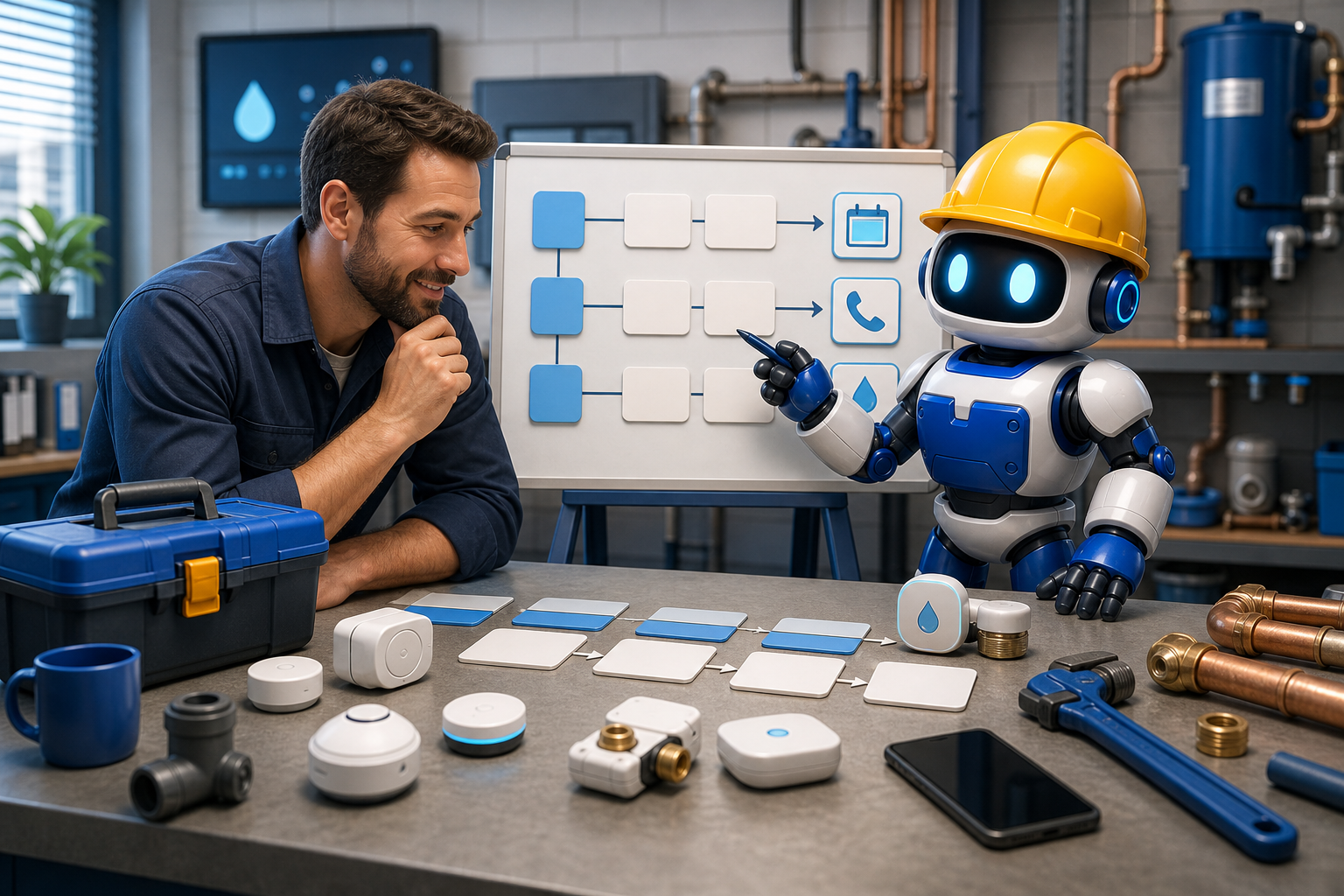
A diagnostic keeps plumbing AI focused on the work: which signals matter, who reviews them, and what can be offered to the customer.
A 30 day pilot for one plumbing service line
Start with one service line. Water heaters, leak checks, pressure complaints, sump pumps, or commercial restroom maintenance can all work, but do not start with everything. Pick the area where repeat calls are common and the office already has decent records.
For 30 days, collect the same basic fields on every selected job: customer problem, fixture or equipment type, age when known, photos, pressure notes when relevant, shutoff location, urgent repair made, recommended follow up, and whether the customer asked about prevention. Keep the list short enough that techs will actually use it.
Then have AI review the completed jobs each week. Ask it to group likely maintenance candidates, flag missing information, draft internal next steps, and separate urgent safety or access concerns from normal service reminders. A manager or licensed lead reviews the queue before anything goes to the customer.
Capture
Collect the same job facts on one plumbing service line for 30 days.
Group
Let AI group repeat issues, missing notes, and likely maintenance candidates.
Approve
Have a qualified person review scope, price, safety, timing, and customer wording.
Offer
Send a plain maintenance option only when the evidence supports it.
At the end of the pilot, ask the hard questions. Did the workflow create useful maintenance visits? Did customers understand the offer? Did techs trust the summaries? Which fields were missing too often? Which alerts wasted time? Those answers matter more than a pretty dashboard.
Where this connects inside GangBoxAI
Start with the plumbing trade page if the workflow needs to fit dispatch, leak checks, water heaters, service contracts, and repeat property work. If the company is still deciding which workflow deserves the first AI pilot, use the AI ROI Diagnostic before buying another tool.
The broader solutions catalog is useful when the maintenance loop touches intake, follow up, job notes, scheduling, and office handoffs. The compare page helps decide whether this should be a custom workflow, a point tool, or a simpler process cleanup.
This article also pairs with the predictive maintenance guide and the missed call guide. For public proof, service pages, reviews, and AI search visibility, GEO Smith can help organize what the business should publish without making ranking promises.
Start with one maintenance use case
Do not start by promising predictive plumbing to every customer. Start by finding the repeat work hiding inside emergency calls. Pick one service line, collect better job notes for 30 days, and use AI to build a reviewed maintenance queue.
If the queue helps the office create clear follow up and useful service visits, expand it. If it creates noise, tighten the inputs before adding more sensors or automation.
Map the plumbing maintenance workflowSources used
- EPA WaterSense: Fix a Leak Week
- Bureau of Labor Statistics: Plumbers, Pipefitters, and Steamfitters
- OSHA: Confined Spaces in Construction
- OSHA: Trenching and Excavation Safety
- NIST: AI Risk Management Framework
- NIST: Challenges to the Monitoring of Deployed AI Systems
- OpenAI Agents SDK: Human in the loop
- Search Central: AI features and your website