
What we will cover
Google AI Mode lets buyers ask detailed questions, compare options, and add follow ups to a synthesized answer with links. That gives a contractor more to answer than a short search phrase.
Your website still needs to rank, while also explaining the work and supporting its claims clearly enough for an AI system to assess fit.
What AI Mode changes
Google describes AI Mode as a way for people to ask whatever is on their mind, continue with follow up questions, and explore helpful web links. It supports text, voice, photos, and image uploads. Google also says AI Mode can organize information, connect users to sources, and help with deeper research.
The important part for contractors is the behavior behind it. A homeowner can ask one long question with all the details that used to take five searches. A facility manager can compare service options, timelines, and risks. A property owner can ask what to check before calling a trade.
Google Search Central says AI features can use a query fan out technique. In plain English, that means one detailed question can turn into many related searches across subtopics and data sources before the answer is built.
AI Mode style search turns one detailed buyer question into related subtopics, sources, and follow up paths.
The buyer journey is shifting
The supplied traffic and survey charts point to the same practical pattern. AI driven discovery is growing, and buyers are doing more research before they talk to sales. Even if the exact numbers vary by industry and source, the direction is clear enough to act on.
Pew Research found that when a Google AI summary appeared, users clicked traditional search result links less often than when no AI summary appeared. Pew also found that users rarely clicked the links cited inside the summary. That does not mean websites stop mattering. It means the content on the website has to work before the click.
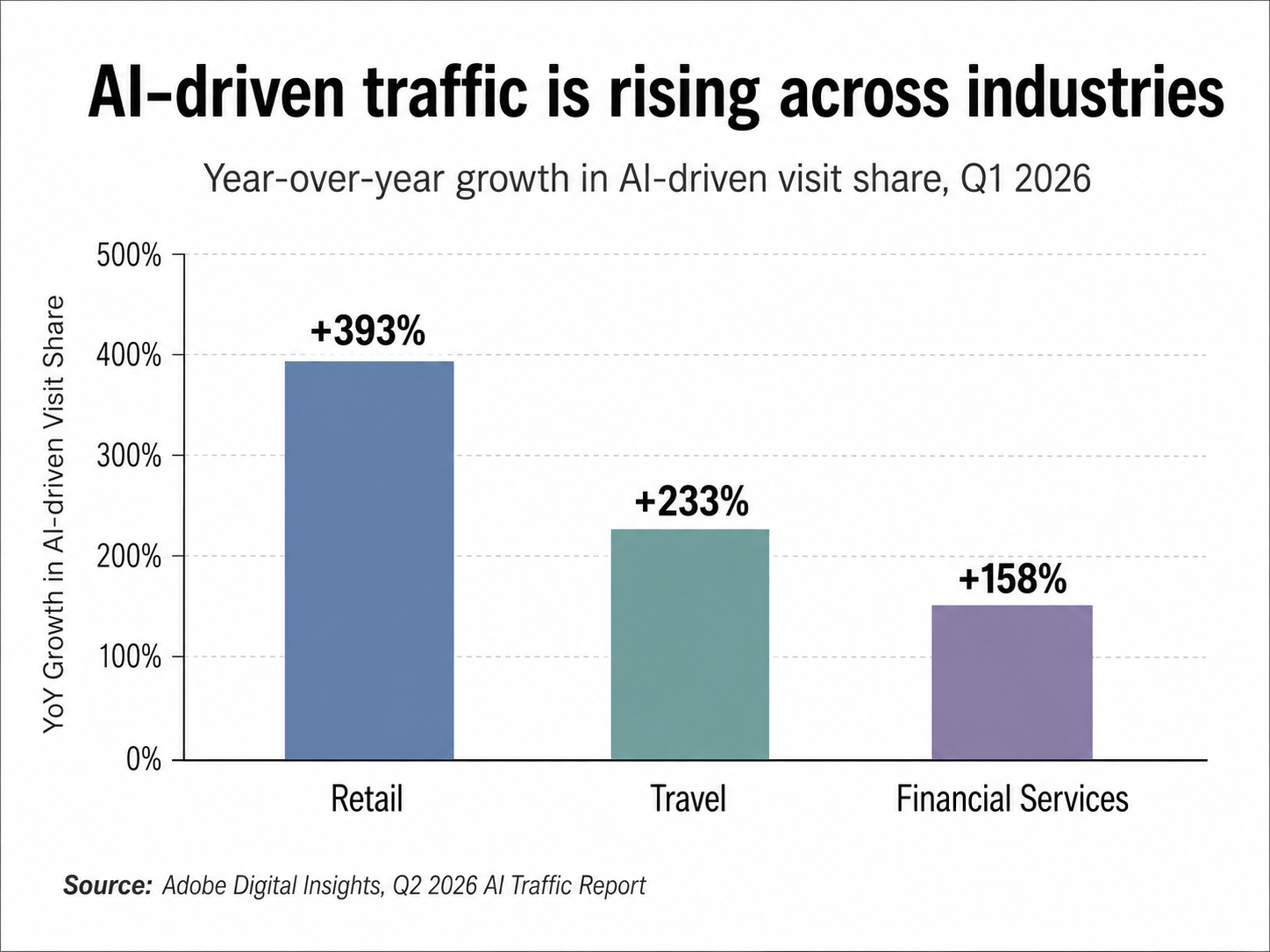
The supplied Adobe Digital Insights chart shows AI driven visit share growth across major industries. For contractors, the signal is directional: AI sourced discovery is becoming part of normal buyer behavior.
Construction buyers are not retail shoppers, but they are still people. The same buyer who asks AI to compare flights or explain a financial product can ask AI which roofer handles storm damage, which electrician can install a generator, or what questions to ask before hiring a concrete contractor.

The supplied buyer journey chart is the important marketing reality: AI can move research earlier and sales conversations later.
SEO, AEO, and GEO have to work together
SEO is still the foundation. Google says the same core search best practices remain relevant for AI features. Your site still has to be crawlable, useful, well organized, and technically accessible.
AEO is the answer layer. It means your content directly answers the questions buyers ask before they call. Not generic FAQ filler. Real answers about service areas, timelines, permits, materials, warranties, safety, pricing ranges, response times, and what happens during the job.
GEO is the generative visibility layer. It means your company is easy for AI systems to understand, summarize, compare, and cite. The Generative Engine Optimization research paper is useful here because it frames the shift from classic rank chasing to improving how content appears inside generated answers.
For contractors, this is not theory. If AI Mode can fan out a question into subtopics, your proof needs to exist across those subtopics. A roofing page cannot only say roof replacement. It should explain inspection, storm damage, insurance documentation, ventilation, materials, warranty, city service areas, and proof from finished jobs.
The practical change
The best contractor website is no longer only a brochure. It is a proof system that helps humans and AI understand who you serve, what you do, and why you are credible.
Contractor proof AI can use
Publish the job records that let someone check your work. Photos, notes, reviews, credentials, and service area details are useful only when the people and systems evaluating the company can access them.
Finished job evidence
Use photos, short project notes, city names, service type, problem, solution, and outcome. A three sentence project note is better than a stock photo and a vague promise.
Review evidence
Detailed reviews help more than generic praise. A review that mentions emergency response, clean up, timing, communication, or the specific work performed gives buyers and AI systems more to work with.
Operational evidence
If you have licensed techs, documented safety process, permit experience, manufacturer training, after hours coverage, or photo based reports, publish it clearly. Do not bury it in a sentence nobody can find.
Local evidence
Your service area should be specific. Name the cities, neighborhoods, counties, and job types you actually want. Add real examples from those areas when possible.
Service pages need better answers
Most contractor service pages are too thin for AI Mode style questions. They list the service, say the company is trusted, and ask for a call. That is not enough when a buyer asks a comparison question.
Answer the questions that come before the call. What's included? Which problems does the service address? When should a buyer avoid waiting? Explain what information to have ready, what affects price and timing, what the crew documents, and where you work.
This is where AI can help the contractor without replacing judgment. A crew lead can dictate a job note. AI can turn it into a draft project summary. A human can approve it. The website gets stronger every week.
Question
List the buyer questions your estimator answers every week.
Proof
Attach real photos, reviews, service areas, and job notes to those questions.
Page
Build or improve one service page so it answers the question clearly.
Check
Search the question in AI tools and record how your company appears.
Improve
Add missing proof, clearer wording, and better local detail.
What to measure now
Classic SEO metrics still matter. Track impressions, clicks, rankings, leads, calls, form fills, and conversion rates. But AI search adds a few new questions.
- Does your company appear when buyers ask AI tools for contractors in your service area?
- Does the answer describe your work accurately?
- Does the answer mention your proof, reviews, service areas, or job examples?
- Are leads arriving better informed because they researched with AI first?
- Are website visits from AI tools converting differently from classic search visits?
Do not panic if traffic patterns move around. The better question is whether your best fit buyers can still find enough proof to trust you.
A 30 day action plan
Start with one profitable service. Do not try to rebuild the whole website in a month.
- Pick one service with good margin and real customer demand.
- Write the ten questions buyers ask before booking that service.
- Add clear answers to the service page in plain language.
- Add three finished job examples with photos and locations.
- Add review snippets that support that service and city.
- Check how AI tools answer buyer questions about that service in your area.
- Repeat the process for the next service after the first page is strong.
Sources and further reading
These sources shaped the article and are useful outbound references for contractors tracking AI search changes.
- Google Search: Meet AI Mode
- Google Search Central: AI features and your website
- Google: Expanding AI Overviews and introducing AI Mode
- Google: AI in Search, going beyond information to intelligence
- Pew Research Center: Google users and AI summaries
- Generative Engine Optimization research paper
GEO Smith turns your contractor proof into AI-search visibility.
GEO Smith audits how AI tools understand your business, finds the missing proof, and helps turn service pages, job photos, reviews, and local signals into content buyers can trust.
See GEO Smith