What we will cover
By the time a buyer searches your company name, they may already have a shortlist.
A homeowner asks a neighbor. A property manager checks an old vendor list. A GC remembers a crew from the last job. Reviews, photos, Facebook groups, repair videos, local directories, and AI answers can all help form those first two or three choices.
AI search does not remove that behavior. It speeds it up. When a buyer asks who handles roof leak repair in a specific town, or who can quote a panel upgrade without wasting time, the answer engine looks for proof it can explain. The contractor with clearer service pages, useful reviews, real job photos, consistent profile facts, and local mentions is easier to understand than the contractor with a vague homepage and a phone number.
Build public evidence for that early decision: what you do, where you work, and why someone should consider calling. No single page can force an AI recommendation, but accurate, accessible records give people and search tools something to check.
The shortlist is forming before your phone rings
Contractors know this pattern in the field. The customer who calls from a referral is usually warmer than the customer who clicked a random ad. They already heard something useful. Maybe it was that your crew cleaned up well, showed up on time, handled permits, or fixed a problem another contractor left behind.
AI search is becoming another referral filter. It can summarize what it finds across your website, profiles, reviews, photos, directories, and public mentions. If those sources do not agree, the system has less confidence. If those sources are thin, it has less to cite. If your best proof lives only in a camera roll, text thread, or old estimate folder, AI cannot use it and buyers cannot inspect it.
That matters because zero click behavior is not theoretical. Pew Research Center analyzed Google search behavior from March 2025 and found users were less likely to click a result when an AI summary appeared. Pew also found people rarely clicked the sources inside the summary itself. Contractors should not read that as panic. They should read it as a reminder that the answer itself may shape the call list.
Contractor rule
Do not wait for the click to prove the business. Put the proof where search engines, answer engines, profiles, and buyers can all inspect it.
What changed in AI search this month
Google published official guidance in May 2026 for optimizing websites for generative AI features in Search. The useful part for contractors is plain: keep the normal search fundamentals strong. Build a clear technical structure, create useful expert content, and avoid fake or low value tactics. Google also warns against chasing inauthentic mentions and says there is no special shortcut such as a separate AI only file or secret markup for its generative search features.
That does not mean every AI system works exactly like Google. OpenAI crawler documentation separates OAI SearchBot from GPTBot. Site owners can allow search discovery while making a different choice about training access. For contractors, the lesson is simple: crawler access, public proof, and robots rules are now part of the visibility checklist.
Recent academic work also points in the same direction. A 2026 arXiv study comparing Google Search, AI Overviews, and Gemini found generative search may retrieve different sources than classic search and may be less consistent across small query changes. Another 2026 study found Google AI Overviews activate much more often for question style queries than for all queries overall. A contractor should expect buyer questions to matter, not just old keyword lists.
Keep doing the SEO work and make the business easier to verify in the places buyers consult before calling.
A contractor proof table for the pre click shortlist
Use this table to decide what should be public, where it should live, and what weak proof usually costs you. The table is not a ranking formula. It is an operating checklist for making the business easier to trust.
| Proof asset | Buyer question | Where it should live | Weak signal |
|---|---|---|---|
| Service page | Do they handle my exact job | website service page | vague copy that could fit any contractor |
| Review language | Can I trust the crew | Google Business Profile and review platforms | short reviews with no service or location detail |
| Job photos | Have they done work like mine | project gallery, profile photos, service pages | unlabeled photos buried in a folder |
| Service area facts | Do they work in my neighborhood | profile, location pages, contact page, directories | service areas do not match across sources |
| Outside corroboration | Does anyone else confirm this business | directories, associations, local mentions, credentials | business only exists on its own website |
| Fresh updates | Are they active right now | recent photos, project notes, profile updates, useful posts | old proof with no recent activity |
A simple chart for proof strength
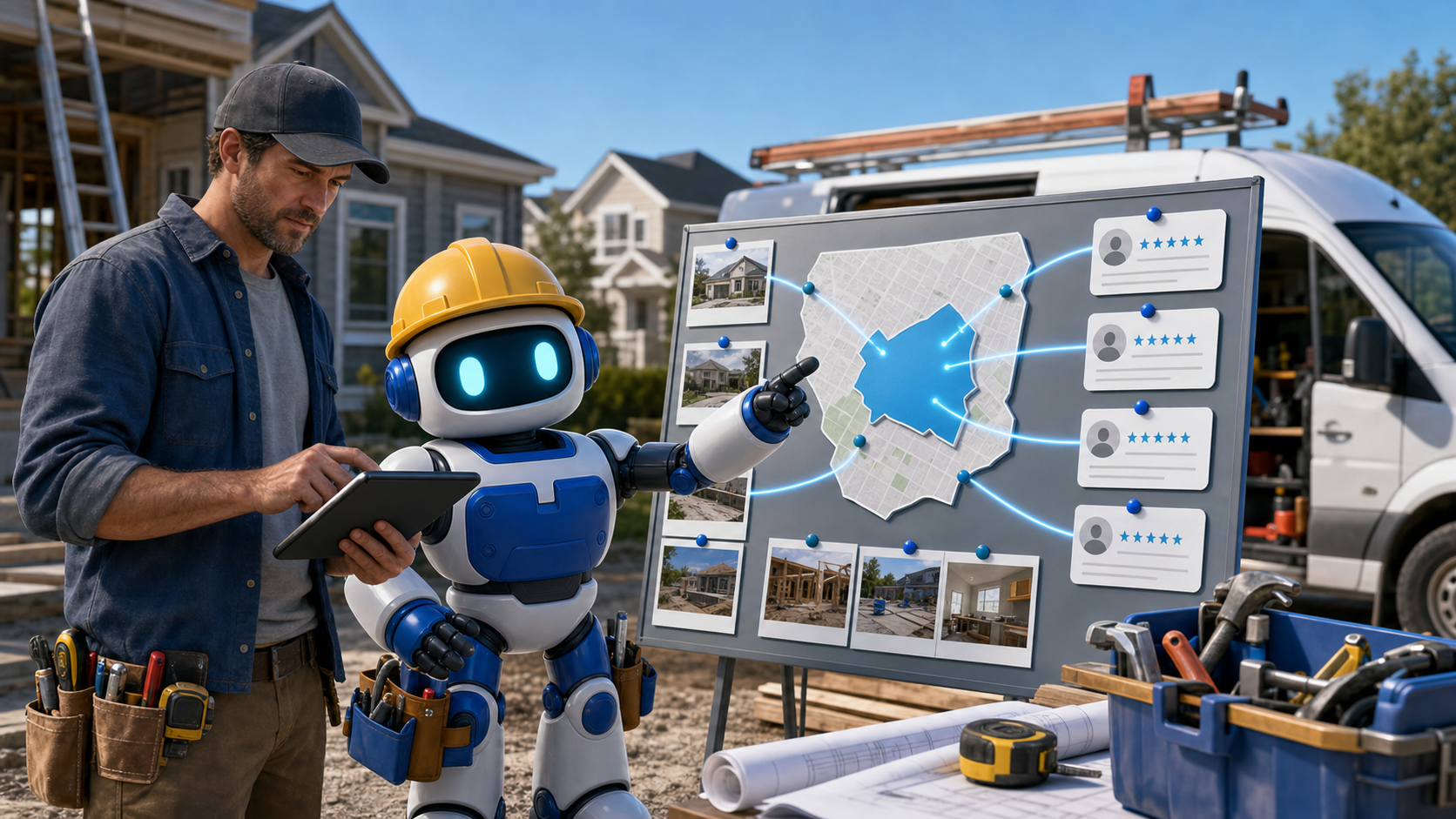
The strongest proof is not one signal. It is the overlap. A service page says what you do. Reviews explain how the work felt. Photos show real jobs. Local profiles show where you work. Outside mentions help confirm that the business exists beyond its own website.
A contractor becomes easier to recommend when service facts, reviews, photos, local proof, and outside corroboration all support the same story.
Build a weekly proof loop, not a random content sprint
Most contractors already create useful proof every week. The problem is that it is scattered. A crew sends photos. The office gets a review. The estimator writes a clean scope. A customer asks a good question. The owner fixes a service page after the same objection comes up three times. None of that helps AI search or future buyers if it never becomes organized public evidence.
Start with one weekly loop. Pick three finished jobs or serious estimates. Pull the useful proof: what service was requested, what town or neighborhood was involved, what problem was solved, what photo can be used, what customer language appeared in the review, and what question the next buyer may ask.
Then place the proof in the right home. A service page may need a stronger answer. A project gallery may need better context. A Google Business Profile may need fresh photos. A review reply may need to mention the actual service in a natural way. A neighborhood page may need one real job example instead of copied city text. A trade page may need a clearer explanation of scope, timing, safety, or access.
Google Business Profile photo guidance says photos can help customers understand a business and should follow profile policies and quality rules. That is a useful standard beyond Google. Good proof is not a pile of random uploads. It is clean, accurate, policy safe, and tied to the work customers care about.
Collect
Pull useful job photos, customer questions, review language, service details, and local context from finished work.
Match
Tie each proof item to the service page, profile, trade page, gallery, or local page where it helps a buyer decide.
Publish
Update public proof in plain language with accurate services, service areas, photos, reviews, and contact paths.
Check
Run AI style buyer questions and inspect whether the answer describes the business accurately and names the right proof.

GEO Smith fits this work because the job is to scan how AI answers see the business, then turn real contractor proof into clearer public signals.
Where this connects inside GangBoxAI
If the problem is AI search visibility, start with GEO Smith. It is built for the scan and improve loop: see how AI style answers understand the business, find missed buyer questions, improve service pages and proof, then monitor what changes over time.
If your public proof is thin, pair this article with the contractor photo proof guide, the review evidence guide, and the neighborhood authority page guide. Those are the pieces that turn real job work into better public evidence.
If your website itself is hard to read, use the AI readable website guide and the agent ready contractor website guide. If the issue is bigger than visibility, run the diagnostic and use the solutions catalog to find the workflow leak behind missed calls, slow estimates, weak follow up, or field documentation gaps.
For local demand around active jobs, The Good Neighbor can support neighborhood awareness. It is not the primary CTA for this article, but job site outreach can create more local memory when it is backed by real proof and a clean follow up path.
Check the proof behind one service
Choose one service and area this week and inspect your public information as a skeptical buyer. Does the page answer the real question? Do reviews and photos show that work? Does the Business Profile list the same services and coverage? Can a directory, credential page, or project mention corroborate it?
If those answers are weak, do not start with a giant content plan. Fix the smallest proof gap first. One clearer service page, one better project example, one useful review reply, and one clean profile update can do more than another thin blog post.
GEO Smith turns your contractor proof into AI-search visibility.
GEO Smith audits how AI tools understand your business, finds the missing proof, and helps turn service pages, job photos, reviews, and local signals into content buyers can trust.
See GEO SmithSources used
- Google Search Central: Optimizing your website for generative AI features
- OpenAI documentation: Overview of OpenAI crawlers
- Pew Research Center: Google users are less likely to click on links when an AI summary appears
- arXiv: How Generative AI Disrupts Search
- arXiv: Measuring Google AI Overviews
- Google Business Profile Help: Tips for business specific photos