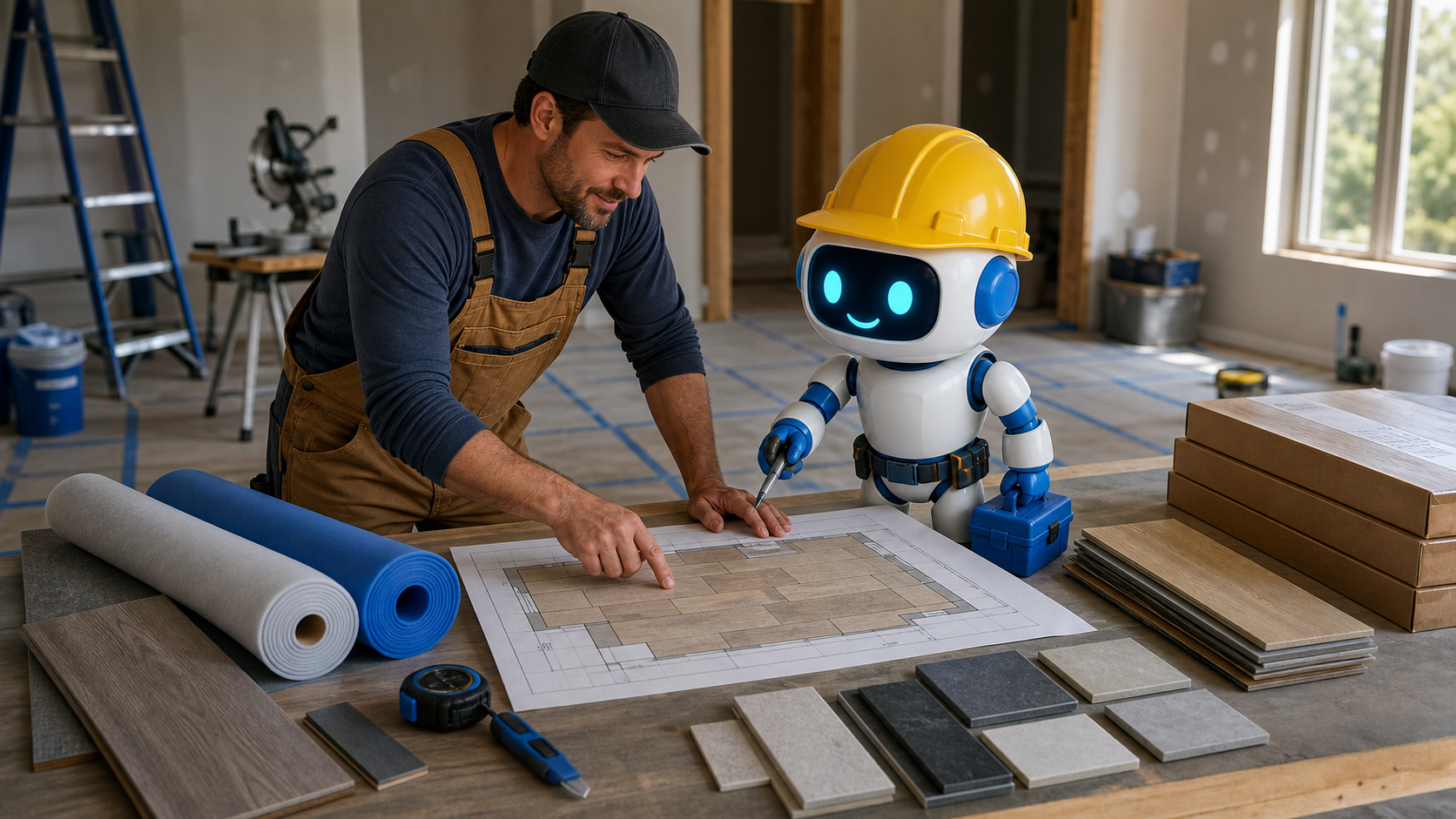
A flooring quote can balance on paper and lose money once the crew starts cutting.
Square footage is only the starting measurement. Pattern direction, plank length, tile cuts, carpet seams, transitions, stairs, closets, and waste affect the takeoff. Subfloor prep, moisture, trim, furniture, haul off, adhesive, underlayment, and material access affect what the crew must do. The quote needs to account for both.
AI helps when it keeps those details from living in memory. It can organize photos, room notes, measurements, material choices, and open questions into a quote packet. A flooring pro still approves the layout, waste factor, scope, safety controls, price, and customer promise.
Treat the AI packet like a dry layout: it helps you see what needs checking before you commit. A room sketch, a few photos, and a product choice leave too many field conditions unresolved to count as a finished bid.
Flooring work punishes guesswork
O*NET lists floor layers as workers who inspect surfaces, measure and mark guidelines, cut and install flooring, and fit materials around walls, door openings, and fixtures. That job description sounds plain because the hard part sits in the details.
A room can measure ten feet by twelve feet and still cause trouble. The floor may have a slope. The customer may want planks running through a hallway without awkward breaks. A tile pattern may create extra cuts. Carpet seams may land in the wrong place. A door transition may need a different profile than the estimator assumed.
Small misses turn into labor drag, extra material runs, callbacks, and rushed customer conversations. The estimator needs a repeatable way to capture the facts before the quote leaves the office.
Flooring rule
Let AI prepare the layout and material packet. Keep waste, prep, safety, scope, price, and schedule under human review.
What AI should collect before the quote
A useful flooring workflow starts with ordinary job information. The estimator should not have to feed the system perfect data. The system should force the same checks every time and show what is missing.
The best input is specific: living room and hall, luxury vinyl plank, run boards lengthwise from front door, remove old carpet, check squeak by hallway, two transitions, one closet, customer wants work before move in, photos attached. AI can turn that into a review packet. The estimator decides whether the layout and waste assumptions hold.
| Flooring input | AI can help with | Human check |
|---|---|---|
| Room measurements | organize room sizes, closets, halls, stairs, and odd shapes into a quote packet | final measurements, allowances, site access, and anything the sketch missed |
| Layout direction | compare plank or tile direction with photos, doorways, hallways, light, and customer preference | final layout choice, seams, transitions, pattern match, and crew install plan |
| Material plan | flag product type, boxes needed, underlayment, adhesive, trim, transitions, and lead time | waste factor, supplier stock, dye lot or batch risk, and delivery timing |
| Prep notes | surface subfloor repairs, moisture questions, leveling, old adhesive, squeaks, and demo scope | site inspection, moisture testing, repair scope, and change order language |
| Safety flags | list dust, cutting, grinding, heavy lifts, ventilation, occupied rooms, and access concerns | PPE, silica controls, crew setup, and whether work needs a site specific safety plan |
| Customer follow up | draft open questions, approved options, and a plain scope summary | tone, price, schedule, exclusions, and final send |
Use the table to find missing information before the customer calls back. If the AI report makes those gaps harder for the estimator to spot, shorten it.
Waste logic needs more than square footage
Waste is not one number for every floor. Pattern match, plank direction, diagonal tile, room shape, closets, stairs, damaged material, and bad cuts all change the order. Product lead time changes the risk too. If the shop orders too little, the job may stop while a crew waits. If it orders too much, margin sits in unused boxes.
AI can compare measurements, photos, material type, and layout notes against the same decision points on each estimate. The human review decides the final allowance because the person who knows the crew also knows how the work gets cut, staged, and installed.
Flooring estimate risk drops when measurements, layout, prep, material, and approval checks sit in one reviewed packet.
The chart shows where AI should push the estimator to slow down. It is a review stack, not a promise. A small straight room with stock LVP needs a different check than a patterned tile job with tight transitions and a short schedule.
Prep and safety checks belong in the packet
Flooring crews do more than place finished material. They demo old flooring, scrape adhesive, cut tile, cut wood, move heavy boxes, kneel for long stretches, and work around dust. OSHA silica guidance matters when work can create respirable crystalline silica. OSHA personal protective equipment guidance also applies when crews need eye, hand, respiratory, hearing, or knee protection for the task.
AI should flag prep and safety questions early: old adhesive, concrete grinding, tile cutting, moisture readings, subfloor repairs, leveling, dust control, ventilation, occupied homes, pets, furniture, stairs, and access for material delivery.
Those flags do not replace a competent person on site. They keep the quote from skipping the boring details that decide whether the job starts clean or turns into a scramble.

A diagnostic keeps flooring AI grounded: which estimate inputs matter, who approves them, and where the workflow stops before the customer sees a price.
A 30 day flooring estimate pilot
Start with one repeatable job type. LVP replacement is a strong first pilot because many contractors see it often, customers expect fast quotes, and the layout still has enough room for waste, transitions, and prep issues.
For 30 days, collect the same packet on each estimate: room list, measurements, photos, existing flooring, product type, plank or tile direction, transitions, stairs, closets, prep issues, moisture checks, waste assumption, safety flags, delivery limits, crew schedule, and who approved the quote.
After each job, compare the approved estimate to what happened in the field. Track extra material runs, unused boxes, cut mistakes, prep surprises, callbacks, and notes the crew wished they had before starting.
Capture
Record measurements, photos, material choice, transitions, prep, and layout notes before leaving the job.
Sort
Let AI organize rooms, cuts, waste assumptions, safety flags, open questions, and customer timing.
Approve
Have the estimator check layout, waste, prep, scope, price, schedule, and customer promises.
Compare
After install, compare the quote to material used, labor, extra runs, prep surprises, and callbacks.
At the end of the pilot, keep the checks that changed real jobs. Cut the checks that only added noise. The first win is a quote packet that helps the estimator think before sending a number.
Where this connects inside GangBoxAI
Start with the flooring trade page when the workflow centers on measurements, layout, material control, prep, and crew handoff. If the company needs help choosing which workflow deserves attention first, use the AI ROI Diagnostic before buying another tool.
The solutions catalog is useful when flooring estimates touch missed calls, job photos, proposal writing, follow up, delivery notes, or customer approvals. The compare page helps decide whether the answer is a custom workflow, a point product, or a cleaner field process.
This article pairs with the AI proposal writing guide because both depend on field notes, photos, exclusions, options, and human approved customer language. If finished flooring jobs, photos, reviews, and service areas should support public visibility later, connect that proof to GEO Smith and the contractor photo proof guide.
Test one layout review
Pick one flooring estimate type. Record the measurements, layout notes, photos, material choice, transitions, prep issues, and waste assumption before leaving the job. Let AI draft the packet. Have the estimator approve the scope, layout, waste, safety, schedule, and price before it reaches the customer.
If the packet cuts quote time and prevents missed field details, expand it. If the AI keeps missing the same prep or layout issue, fix the intake checklist before adding more automation.
Map the flooring workflowSources used
- BLS: Flooring Installers and Tile and Stone Setters
- O*NET Online: Floor Layers, Except Carpet, Wood, and Hard Tiles
- NWFA: Technical Guidelines
- OSHA: Respirable Crystalline Silica in Construction
- OSHA: Personal Protective Equipment
- NIST: AI Risk Management Framework
- OpenAI Agents SDK: Human in the loop
- Search Central: AI features and your website
- Search Central: Optimizing for generative AI search